
Can You Track Helicopters and Military Planes on a Flight Tracker?
A helicopter circles over your street, or a grey military jet goes over low and loud. You open a flight tracker, and there's nothing there. Other days the same kind of aircraft shows up clearly. Here's why, and what you can and can't expect to see.
Short answer: yes, sometimes. Helicopters and military aircraft appear on fly24 when they broadcast their position (ADS-B) and a receiver on the ground can hear them. Many helicopters fly too low to be heard far away, and many military aircraft switch position broadcasts off or never send them, so a tracker will always show only some of them.
How any aircraft gets on the map
Live trackers like fly24 don't use air traffic control radar. They show aircraft that broadcast their own GPS position by radio, a system called ADS-B, and they rely on volunteer receivers on the ground to pick up that signal. For an aircraft to appear, two things must be true:
- It is sending its position.
- A receiver is close enough to hear it, with no hills or buildings in the way.
Airliners at 35,000 feet are easy on both counts: they must broadcast in most of the world, and from that height a receiver can hear them 300 km or more away. Helicopters and military aircraft often fail one test or the other.
Tracking helicopters
Most modern helicopters used by police, air ambulances, news crews, offshore oil workers and tour companies carry a transponder, and many broadcast ADS-B. The problem is height. A helicopter at 500 to 1,500 feet is hidden from distant receivers by the curve of the earth, terrain and buildings. A receiver 30 km away may hear an airliner perfectly and miss a helicopter right over your town.
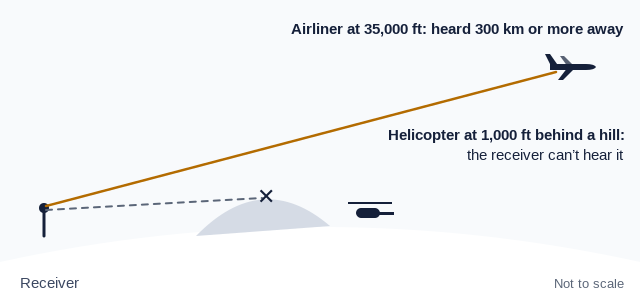
That's why helicopters on trackers often:
- Show up only in cities with lots of receivers, such as London, New York or Sydney.
- Appear and disappear as they move behind hills.
- Show a broken trail with gaps.
To find a helicopter on fly24: tap Near me (◎) on the live map and zoom in close. Look for a slow-moving aircraft (under about 150 knots) at low altitude, often moving in circles or stopping. Tap it: the aircraft type in the flight panel will name a helicopter model such as an Airbus H135, H145 or AW139.
Air ambulance and life flight helicopters
Medical helicopters are among the easiest helicopters to track, because they fly to and from hospitals and usually broadcast ADS-B. In the UK many use radio callsigns starting with Helimed. In some countries operators ask for their flights to be hidden for patient privacy, and those won't appear on any public tracker.
If you're waiting for news of someone flown by air ambulance, the hospital or the ambulance service is the right source, not a flight tracker.
Tracking military aircraft
Military aircraft follow different rules. They often:
- Switch ADS-B off during training, operations or anything sensitive.
- Send only part of the signal, enough for air traffic control to identify them but without a position, so a tracker can't place them on a map.
- Broadcast normally on routine flights through civilian airspace. Transport planes, air-to-air refuelling tankers and VIP aircraft are often visible this way.
The military flights you can see are usually large aircraft flying routine routes, with callsigns that don't match any airline. Fast jets, combat helicopters and anything on an exercise usually don't appear at all.
Some networks also calculate positions for aircraft that don't send GPS data, by timing their signal at several receivers at once (called multilateration, or MLAT). This works only where many receivers overlap, so it fills in a few gaps in busy regions rather than revealing everything.
Don't use a tracker to judge what's happening in the sky during a security event. What's missing tells you very little: an empty map can simply mean the aircraft isn't broadcasting.
Private jets and blocked aircraft
Some owners of private and business aircraft can ask aviation authorities to limit how their flights are shown. In the United States, for example, the FAA runs two programs for this: LADD (Limiting Aircraft Data Displayed), which lets owners block their flight data, and Privacy ICAO Address (PIA), which lets them use a temporary transponder address. (That PIA has nothing to do with Pakistan International Airlines.) These aircraft may appear without a registration or callsign, or not at all.
What you'll never see
- Drones. Small drones don't use ADS-B and don't appear on flight trackers.
- Gliders and microlights, in most cases. They rarely carry ADS-B transponders.
- Aircraft far from any receiver, such as over remote deserts, mountains and oceans. Read why some flights are missing.
Quick guide: what to expect
| Aircraft | Usually visible? | Why |
|---|---|---|
| Airliners | Yes | Must broadcast ADS-B; fly high, so heard from far away |
| Business jets | Mostly | Broadcast ADS-B, but some owners block their details |
| Air ambulance helicopters | Often, in well-covered areas | Broadcast ADS-B, but fly low |
| Police helicopters | Sometimes | May switch off broadcasts during operations |
| Military transport and tankers | Sometimes | Broadcast on routine flights in civilian airspace |
| Fighter jets | Rarely | Usually don't broadcast position |
| Drones | No | Don't use ADS-B |
Spotted something unusual?
If a plane is circling for a long time, check its squawk code in the flight panel. Codes like 7700 mean an emergency; most circling is just a plane waiting to land. See squawk codes explained, or read what plane is flying over me for how to identify aircraft overhead.
Open the live map and zoom in on your area to see what's flying near you now.